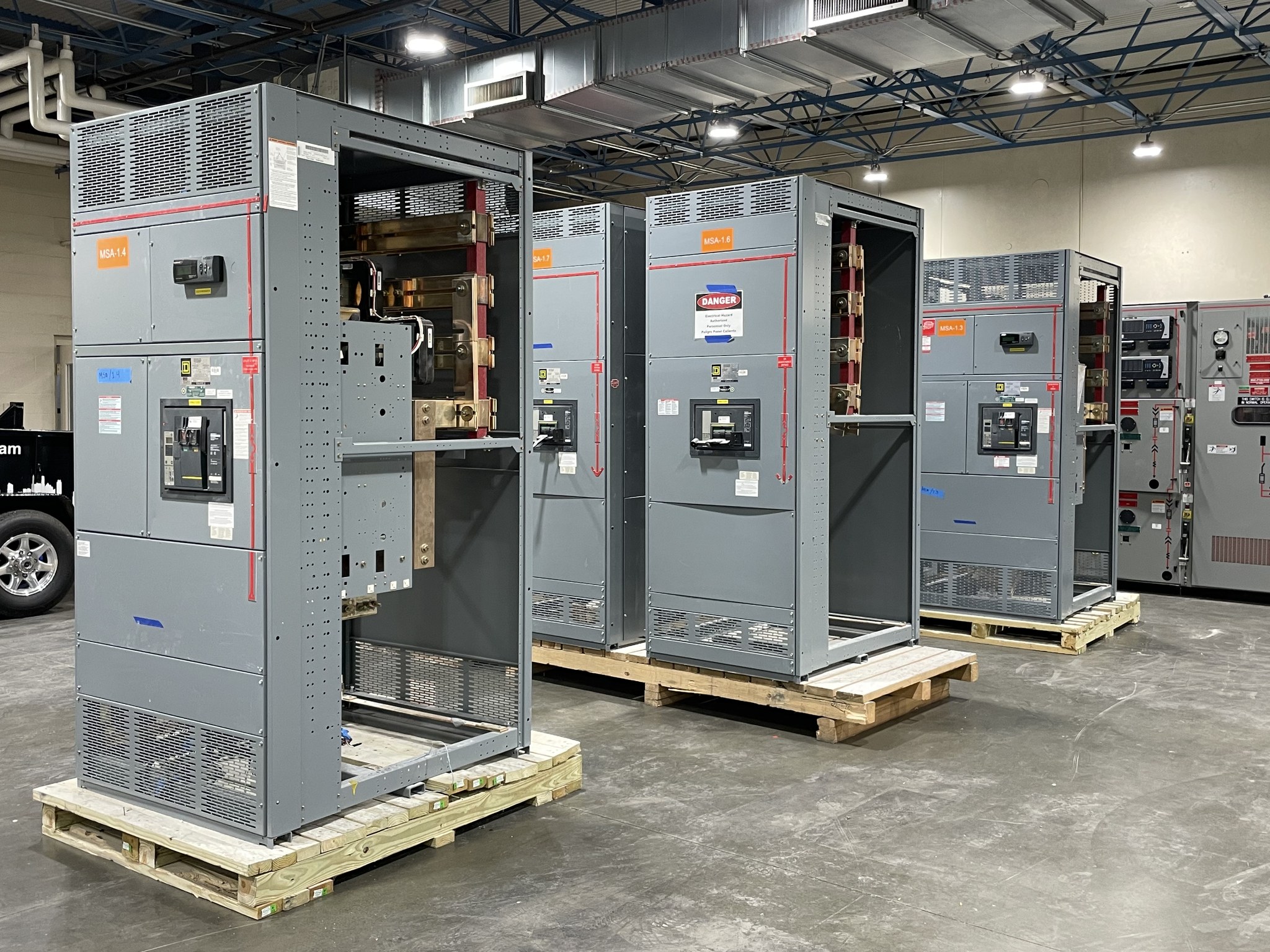
Count breaker cells, not just lineup sections
Begin with a lineup-level description: identify the number of vertical sections, then record the breaker compartments or cells in each section. A hypothetical lineup might have four sections, with two breaker cells in one and a different arrangement in the others. That is more useful than saying only “four-section gear,” because section count does not establish how many drawout breaker positions the equipment contains.
Where paperwork or safely accessible exterior information identifies a cell’s purpose, note it without treating an old label as proof of electrical rating. Record the wording as shown and distinguish it from verified documentation. Ampere ratings and voltage ratings are separate characteristics; neither should be inferred from the other, a compartment’s appearance, or a page title. An equipment buyer can review the descriptions and supporting records together.
Describe partitioning and compartment boundaries
Metal-clad construction relies on compartmentalization, so describe the boundaries visible in existing drawings or safely accessible exterior views. Note whether the lineup has distinct breaker, bus, instrument-transformer, or cable compartments when records identify them. Describe apparent partitions and barriers carefully, including any documented changes, rather than assuming every section has an identical internal arrangement.
A missing panel, altered partition, or nonmatching section can affect how a buyer understands the lineup and its completeness. Do not open enclosures or remove covers to investigate. Instead, share available drawings, maintenance records, photographs taken from a safe location, and a straightforward note about known modifications. If the configuration is uncertain, label it as uncertain; that is more useful than presenting a guess as a confirmed feature.
Keep each breaker matched to its cell identity
The most useful inventory preserves the association between a breaker and the cell it came from. Use consistent identifiers from existing labels or drawings—such as lineup section, cell designation, and breaker identifier—and keep those identifiers together in a list. If breakers have been removed or stored separately, record the known original positions and clearly mark any relationship that cannot be confirmed.
For example, suppose a hypothetical lineup has cells A1 through A6 and three breakers are stored in a separate room. Listing each breaker beside its documented former cell gives the buyer a clearer picture than reporting “six cells, three loose breakers.” Do not force a fit, operate a breaker, or test it to establish identity. Existing paperwork and safely accessible markings are the appropriate sources for an initial inventory.
Include interlocks and condition without unsafe inspection
Mechanical interlocks are part of the lineup’s configuration, not incidental hardware. Existing diagrams or records may describe interlocks that restrict breaker movement, prevent certain operating sequences, or coordinate related compartments. Note documented interlock arrangements, known missing components, and any history of modifications. Avoid claiming a mechanism works based only on its presence or appearance; functional condition requires appropriate professional assessment.
Describe condition in observable, qualified terms: for instance, “drawout breakers listed in the maintenance record” or “one cell identified as incomplete in the available notes.” Do not ask staff to operate equipment, touch conductors, test, measure, or approach energized apparatus. The buyer can review the information and discuss what it means for a specific offer. Electrical work, if needed, must be handled by qualified professionals.
Coordinate review, removal, and payment before pickup
An Illinois buyer of used, surplus, and decommissioned electrical equipment can review metal-clad drawout gear from data centers, shut-down power plants, and other sites. Share the lineup inventory, available ownership or disposition information, photographs that can be obtained safely, and site constraints such as access routes, loading conditions, or required scheduling. A clear account of what is included—breakers, sections, and associated equipment—helps the buyer assess the particular opportunity.
The company makes cash offers, with payment upfront rather than after pickup; no seller testing is required, and freight is covered. It handles crane, rigging, disconnects, loading, freight, and hauling, so the seller is not expected to dismantle or move the gear. Details and any specific offer remain subject to review. Discuss site access and project coordination in advance; qualified professionals perform electrical work as appropriate.
Common questions
Why keep a breaker linked to its original cell if both are included?
The relationship helps clarify the lineup’s configuration and inventory completeness. Use documented section and cell identifiers where available, and flag uncertain matches instead of assuming a breaker belongs in a particular position.
Should we operate drawout breakers to confirm cell fit before requesting an offer?
No. Do not operate, test, or handle equipment for identification. Share existing drawings, records, and safely accessible exterior information; the buyer can discuss the inventory and any specific offer after review.
What should we say if interlock details or partitioning are unclear?
Describe what available records show, identify gaps or known alterations, and avoid presenting assumptions as facts. Do not open enclosures to investigate; qualified professionals handle electrical work as appropriate.