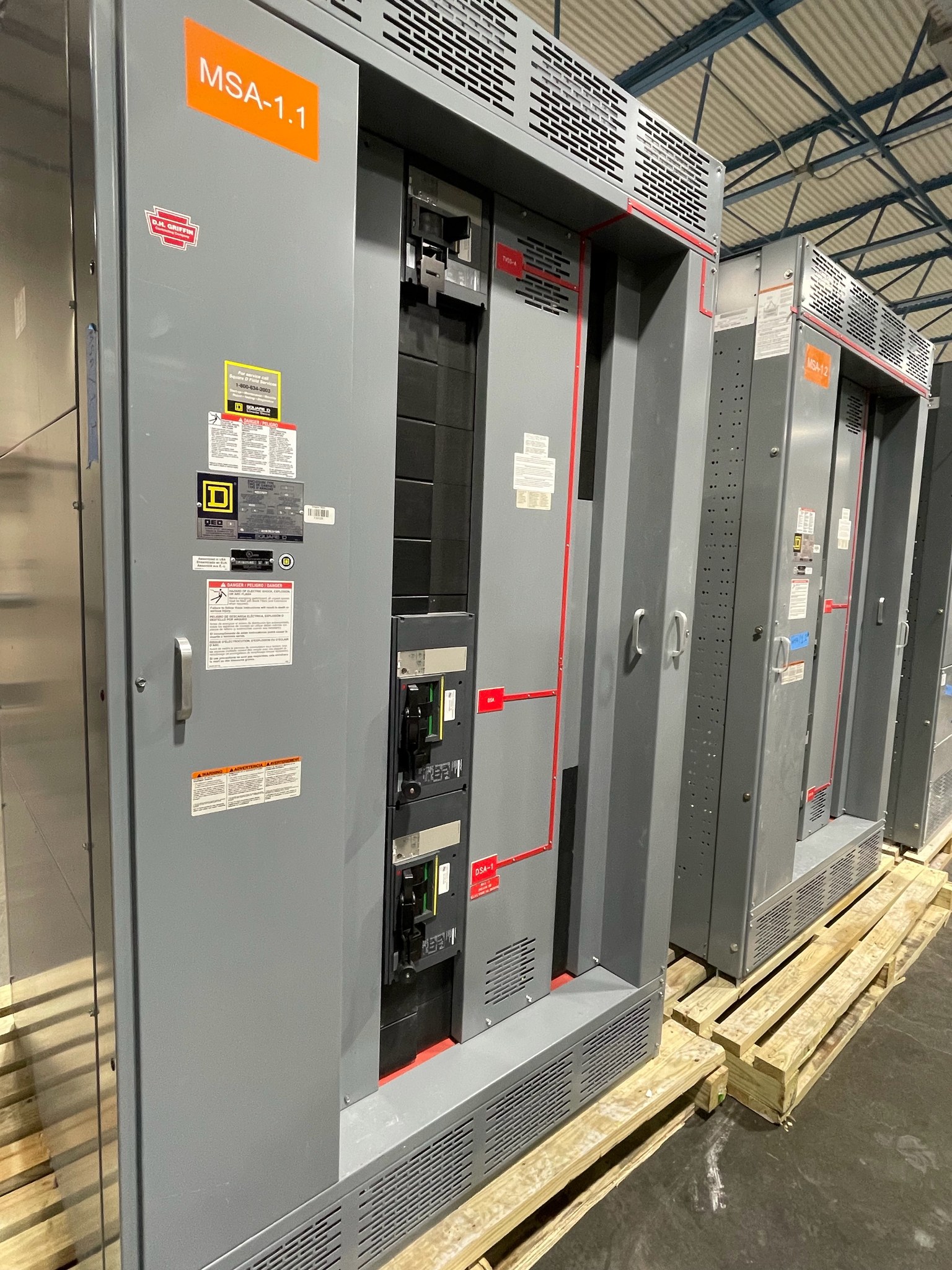
Inventory the lineup as a coordinated lot
Start with the physical lineup, not an assumed nameplate rating. Record the number of sections, their apparent order, visible equipment identifiers, and any attached shipping or lineup labels that can be read safely from outside. A one-line diagram, equipment schedule, or prior project inventory may clarify whether sections belong together. Treat the inventory as a description for review, not proof of electrical condition or compatibility.
If a hypothetical facility has a main section and several feeder sections removed from the same installation, list them together and note any known gaps or separately stored pieces. Include loose items only when their identity and relationship to the lineup are clear. This helps distinguish a complete offered lot from a partial lineup while avoiding unsupported claims about operating readiness, protection coordination, or suitability for reuse.
Record breaker models and protection components separately
For each feeder breaker, transcribe the manufacturer, model or catalog designation, frame or type information, and any legible nameplate details from existing documentation or safely accessible exterior markings. Keep ampere ratings and voltage ratings in separate fields: one does not establish the other. If a figure appears only in a seller’s notes or a page heading, identify it as reported rather than verified against equipment documentation.
Make a separate list of protection-related components shown in records or visibly included with the lot, such as trip units, relays, auxiliary devices, or control-power components. Note quantities and identifiers where available, and flag missing, uncertain, or separately stored items. These details assist an initial review; they do not establish settings, calibration, coordination, interrupting capability, or protective performance. Do not open enclosures or operate, test, measure, or touch equipment to fill gaps.
Preserve configuration records and label uncertainty
Useful records may include lineup drawings, one-line diagrams, breaker schedules, relay or trip-unit documentation, wiring diagrams, bills of material, and prior maintenance or commissioning paperwork. Share copies when available and label them by document type and revision if known. A drawing can describe the intended arrangement without proving that the present lineup still matches it, so point out known changes rather than silently treating old records as current.
Where information conflicts, preserve the discrepancy for the buyer to review. For example, a hypothetical breaker schedule may identify a model that differs from an exterior label, or a drawing may show a section no longer present. Record both descriptions and their sources instead of deciding which is correct. Clear uncertainty is more useful than an unqualified claim, and no paperwork should be presented as a substitute for inspection or performance verification.
Describe condition and ownership without taking equipment apart
Give a straightforward account of the lineup’s known history: whether it is surplus, removed during a facility closure, or associated with a decommissioned data center or shut-down power plant. Note visible exterior damage, missing covers, storage exposure, or components already known to be absent, based on existing records or safe observation. Do not represent equipment as de-energized or all electrical work as complete unless that status has been established by qualified personnel.
The Illinois buyer considers used, surplus, and decommissioned electrical equipment, including switchgear across voltage classes. An initial conversation can cover the lineup description, available photographs of safely accessible exteriors, documents, ownership, and what is included. Any particular offer and purchase details remain subject to review; sharing a model number or a favorable condition description does not guarantee acceptance or a specific price.
Coordinate removal as a project, not a seller’s dismantling task
Before discussing pickup, describe the site constraints that may affect planning: the lineup’s general location, access route, loading area, known crane or rigging needs, and relevant facility rules. Share what is already known about disconnects and removal status, without assuming that electrical work is finished. Qualified professionals handle electrical work as appropriate; the seller should not be asked to open gear, disconnect conductors, dismantle sections, rig loads, or move the equipment.
For accepted equipment under agreed terms, the buyer handles crane, rigging, disconnects, loading, freight, and hauling, with freight covered. Payment is upfront, not after pickup, and no seller testing is required. In a hypothetical constrained plant room, early notice of a narrow doorway or restricted loading window helps the parties review logistics; it is not a promise that every site condition or item can be accommodated.
Common questions
What should I provide if feeder breakers have different model numbers or trip units?
List each breaker and any included trip unit or relay by its available identifier and quantity. Attach relevant schedules or drawings, and mark missing or conflicting details as uncertain rather than inferring function or performance.
Does a lineup drawing prove the offered switchgear is complete or correctly configured?
No. Drawings help describe intended arrangement, but the present equipment may differ. Identify the document and revision if known, report visible or recorded gaps, and let the buyer review the lot and records.
Do I need to test, disconnect, or move the lineup before asking for an offer?
No seller testing is required, and the seller is not expected to disconnect, dismantle, rig, load, or haul it. Share available information for review; agreed removal work is coordinated by the buyer with qualified professionals as appropriate.