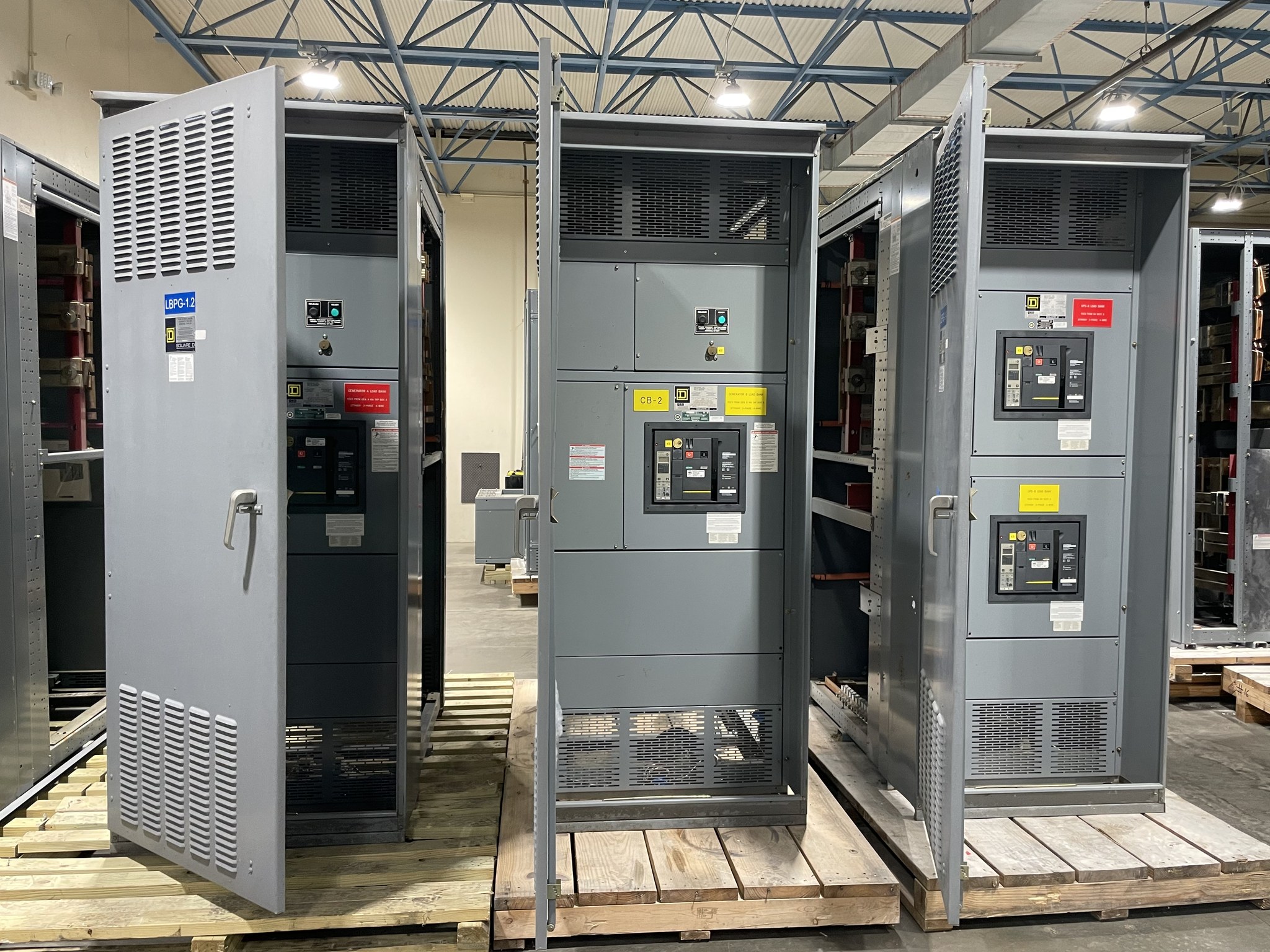
Keep each breaker’s documented cradle match intact
Before equipment is separated for shipment, gather existing schedules, maintenance records, lineup drawings, photographs, and labels that identify each breaker and its intended cradle or cubicle. A useful inventory links the breaker’s own manufacturer and catalog or type information to the corresponding cradle identification. Do not rely on physical resemblance alone: breakers that appear similar may belong to different applications or lineups.
If the records are incomplete, say so rather than filling gaps with assumptions. For example, a hypothetical lot might include three breakers and two cradles, while an old schedule identifies only two pairings. Report that discrepancy and share the available documentation. The buyer can review what is known and ask focused follow-up questions without treating an unverified match as established fact.
Describe ratings and configuration from evidence
Provide the information shown on safely accessible exterior nameplates or existing paperwork, such as manufacturer, model or type, serial number, interrupting information, and stated ratings. Keep voltage and ampere ratings distinct: one does not establish the other. A page title, handwritten lot description, or seller’s shorthand is not a verified rating, so identify it as a description unless documentation confirms it.
Clarify whether the offered group consists of breakers only, breakers with matching cradles, or a larger assembly. Note any known accessories, secondary disconnects, shutters, or stored spares only when records or safe exterior observation support the description. Do not open an enclosure or operate equipment to obtain details; qualified professionals handle electrical work as appropriate.
Report condition without performing tests
A useful condition account separates what is documented from what is merely unknown. You can share existing inspection records, service history, known removal circumstances, visible exterior damage, or whether paperwork identifies prior maintenance. If a breaker’s operating history is unavailable, say that plainly. The company does not require the seller to test equipment, and a written condition note is not a substitute for a test report.
Avoid trying to demonstrate operation or inspect internal components for a sale. Do not touch conductors, open equipment, measure, test, or approach energized apparatus. If the site team has already prepared records through its normal qualified procedures, those records can help the buyer understand the lot; otherwise, provide only information that is already available and safely accessible.
Coordinate shipment while leaving restraint choices to qualified handlers
Drawout breakers and their cradles can be separate pieces with different shapes, weights, and handling requirements. Tell the buyer how many pieces are present, where they are located, whether they are already staged, and what site access constraints may affect removal or loading. Share known limits such as scheduled access windows or loading-area restrictions, but do not dismantle, rig, or move equipment for the sale.
A qualified handler should choose the safe securing and packaging methods for the particular breaker, cradle, and transport arrangement. The seller should not improvise restraints or assume that a breaker can be shipped seated in its cradle. For a hypothetical example, two visually similar breakers may require separate identification and restraint because their documented pairings differ. The buyer handles coordination for disconnects, rigging, loading, freight, and hauling.
Submit a clear lot description and review the offer
For an initial review, send an itemized count, safely accessible identification, available pairing records, known condition, location in Illinois, and a few exterior photographs if they can be taken safely. Identify gaps explicitly: “cradle match not documented” is more useful than a guess. The company buys switchgear, switchboards, MCCs, panelboards, busway, transfer switches, breakers, and unit substations, including equipment from decommissioned data centers and shut-down power plants.
The buyer reviews the details and discusses a specific offer and removal plan with the seller; an inquiry does not guarantee that every item will be accepted. For agreed equipment, payment is upfront, not after pickup, and the stated terms include cash offers with freight covered. The seller is not expected to test, dismantle, rig, load, or arrange hauling. Qualified professionals perform electrical work as appropriate.
Common questions
What if I cannot prove which cradle belongs with each drawout breaker?
List each breaker and cradle separately, share any available schedules or photographs, and mark uncertain pairings as unknown. The buyer can review the documentation and clarify what can be included in a specific offer.
Do I need to test the breakers or prepare them for shipment?
No seller testing is required. Do not operate or open equipment to prepare it. A qualified handler chooses appropriate securing methods, while the buyer coordinates agreed removal, loading, freight, and hauling.
What details help the buyer distinguish a breaker’s voltage from its ampere rating?
Share safely accessible nameplate information and existing records that identify each rating separately. Do not infer voltage from amperage or treat a listing title or informal description as verified rating documentation.