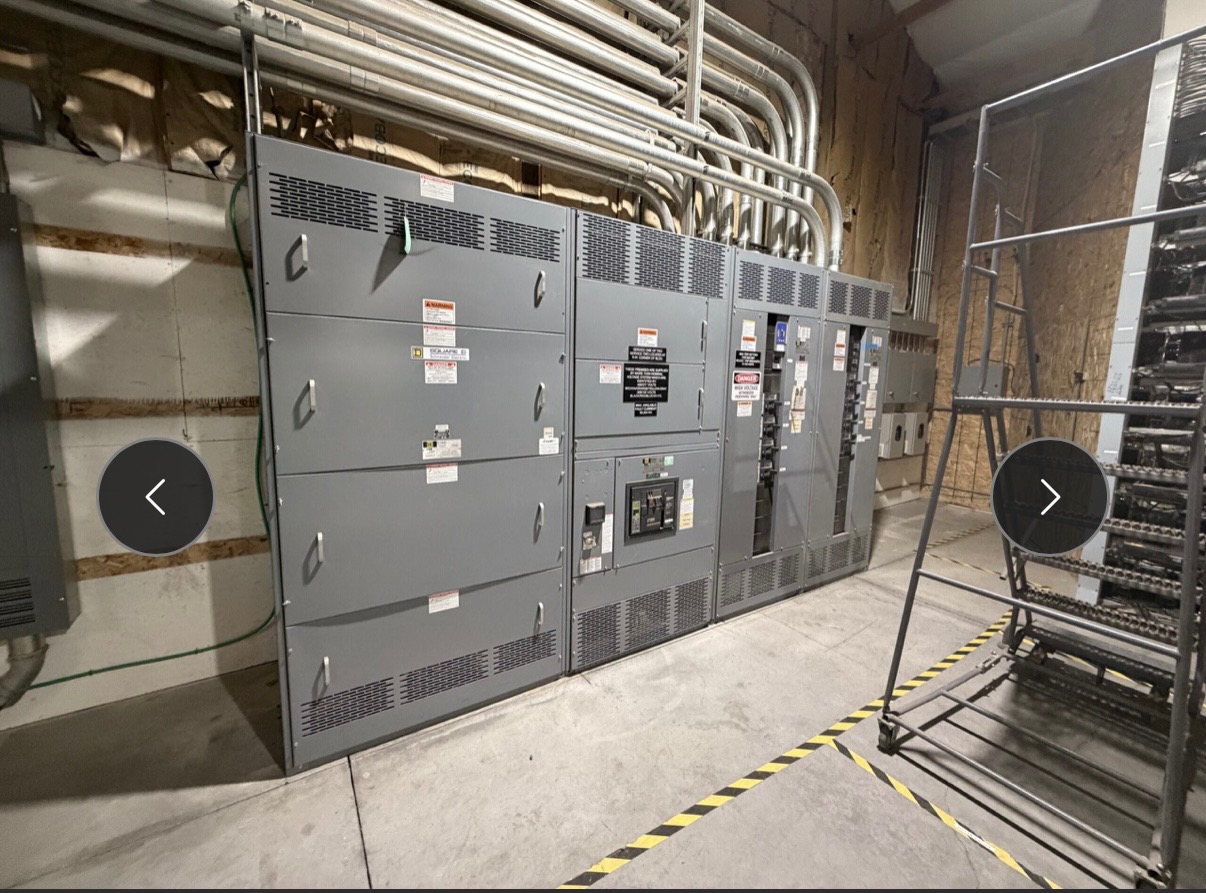
Trace both incoming sources and the tie arrangement
Begin with the power-system documentation, especially an existing one-line diagram, lineup drawings, and nameplate or equipment schedules that can be consulted without opening enclosures. Identify how the two incoming sources are shown and whether the arrangement includes a tie breaker, tie section, or other switching device. “Throw-over” may describe the operating scheme, but it does not by itself establish the physical lineup or its exact configuration.
For example, a hypothetical lineup might show one incoming breaker for each source and a tie breaker between two bus sections. Another drawing might depict a different bus arrangement or a transfer scheme without that same tie configuration. Do not infer the arrangement from a seller’s page title or a brief label. If documentation is incomplete, describe what is known and mark the uncertain details for review rather than filling gaps with assumptions.
Separate the complete lineup from an individual ATS
An automatic transfer switch, or ATS, is a device that transfers a load between sources. Automatic throw-over switchgear may instead refer to an integrated lineup containing incoming breakers, bus sections, a tie, protection, and transfer-control components. A standalone ATS and a multi-section switchgear lineup are not interchangeable descriptions. State whether the offer covers the full lineup, a defined group of sections, or only an individual transfer device.
A practical inventory can list each section by its existing designation or lineup position and note what is included, such as incoming, tie, or control sections, where the records support that description. Also identify anything excluded or already removed. If a control cabinet or tie section has been separated from the rest, say so; the buyer needs to understand the offered package, not merely the equipment’s former operating purpose.
Use records to describe ratings and transfer controls
Share available drawings, schedules, manuals, and photographs of safely accessible exterior labels. Report voltage and ampere ratings separately and only when documentation identifies each rating and its context. An ampere value is not a voltage value, and neither should be inferred from the other. Manufacturer and model markings can help identify equipment, but they are identifiers rather than proof of an exact lineup rating or a guarantee that every component remains present.
Transfer-control information can be especially useful: existing control diagrams, relay or controller model references, source-sensing descriptions, and documented operating sequences may clarify how the throw-over scheme was intended to work. Do not operate the gear, open an enclosure, test it, or approach energized apparatus to collect details. There is no requirement for seller testing. Existing records and safely accessible exterior information are a sensible starting point, with uncertain control details explicitly noted.
Describe condition, ownership, and what remains in place
Give a factual account of known condition and history: whether the equipment is installed, stored, decommissioned, or partly dismantled; whether sections or control components are missing; and whether records mention repairs or prior modifications. Avoid presenting an assumption as a verified condition assessment. No seller testing is required, and an inability to confirm internal condition should be stated plainly rather than resolved by asking anyone to inspect inside.
Confirm that you own the equipment or are authorized to arrange its sale, and clarify whether the available package includes connected or adjacent equipment that is not part of the throw-over lineup. A hypothetical seller might have the original incoming and tie sections in place but find that a controller was removed during a project. That distinction is useful to disclose early; it lets the buyer review the actual package without implying that every described component is present.
Coordinate a review and plan removal around the site
An Illinois buyer of used, surplus, and decommissioned electrical equipment can review switchgear from decommissioned data centers, shut-down power plants, and other sites. Send the available equipment description, records, and safely obtained photographs so the specific configuration can be reviewed. Any offer and scope remain subject to that review. The buyer’s terms are cash, payment upfront, no seller testing required, and freight covered; payment is not deferred until pickup.
If the equipment is accepted, removal coordination can include disconnects, crane and rigging, loading, freight, and hauling, so the seller is not expected to dismantle, rig, or move the gear. Qualified professionals perform electrical work as appropriate. Discuss access, pickup constraints, equipment location, and what remains connected before scheduling; do not assume the gear is de-energized or that electrical work is complete. Site conditions and the agreed scope need to be reviewed for the specific project.
Common questions
Does automatic throw-over switchgear mean the same thing as an ATS?
Not necessarily. An ATS is an individual transfer device; throw-over switchgear may be a multi-section arrangement with two incoming sources, bus sections, a tie, and controls. Describe the offered components and consult existing drawings.
What should I provide about the two sources and tie?
Share available one-line diagrams, lineup drawings, schedules, and safely accessible exterior identification. State what the records show about each incoming source and any tie section, and flag unknown details instead of inferring them.
Do I need to test or dismantle the lineup before asking for an offer?
No seller testing is required, and the seller is not expected to dismantle, rig, or move accepted equipment. A specific offer is subject to review; payment is upfront, with freight covered and removal coordination arranged.