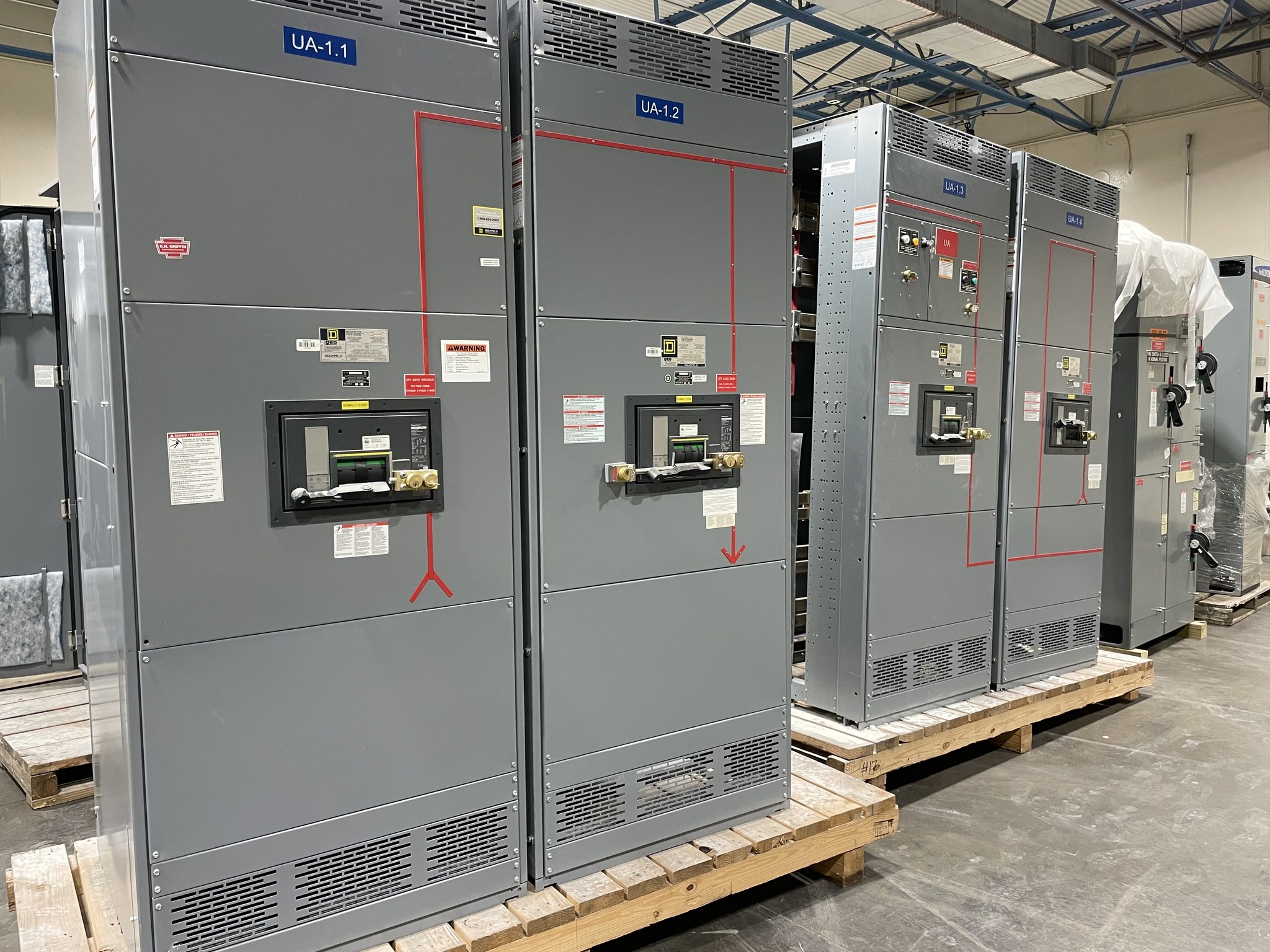
Confirm the 2,000-amp rating from existing records
Start with information already available: equipment schedules, purchase records, drawings, nameplate photographs taken from a safely accessible exterior, or an asset inventory. A listing that calls the material “2,000-amp busway” is a useful lead, but it does not independently verify the rating. Share the source of the description and distinguish documented facts from estimates or inherited labels.
Amperage and voltage are separate specifications. A 2,000-amp designation describes current capacity; it does not establish the busway’s voltage class, phase arrangement, or other electrical characteristics. If records show those details, include them as documented. If they are missing or unclear, say so rather than infer them from the ampere rating, an old project title, or the appearance of a section.
Describe the run as sections, fittings, and connections
A useful inventory separates straight runs from fittings instead of treating every piece as an equivalent length of busway. Report approximate section counts or lengths when known, then list joints, elbows, offsets, end pieces, tap-off units, or other components only when they are present and identifiable. Note whether quantities come from records, a safe visual inventory, or an estimate; do not open equipment to improve the count.
For example, a hypothetical lot might contain several straight sections, a pair of elbows, and joints kept with the run. Another might consist mainly of straight sections with no documented fittings. Those are materially different configurations even if both are described as 2,000-amp feeder busway. Existing drawings, bills of material, and exterior photographs can help convey the layout without asking anyone to disconnect or inspect internal conductors.
Explain phase configuration and what is unknown
Phase configuration can affect whether sections belong together, so relay only what the records or accessible markings establish. A drawing may identify a three-phase feeder, while a separate schedule may note a neutral or a particular arrangement. If the documents conflict, are incomplete, or appear to cover more than one run, flag that uncertainty for review rather than combining their details into one confident description.
A photograph or label may be helpful for identification, but it should not be treated as proof of every specification. Do not operate busway, test it, measure conductors, remove covers, or approach energized apparatus to gather details. Where condition or electrical status is not documented, describe that limitation plainly. Qualified professionals handle electrical work as appropriate; a seller need not perform testing or prepare the assembly for inspection.
A partial run is not the same as a complete assembly
A complete assembly generally means more than having a substantial number of straight sections. Continuity of the route, compatible joints, required fittings, transitions, and known end conditions can all matter when reviewing whether the listed pieces form a coherent run. A lot missing an elbow, a transition, or an identifiable connection may still be worth presenting, but it should be represented as partial rather than as a ready-to-reuse complete assembly.
Consider a hypothetical decommissioned section with straight runs and joints but no records showing the original route or the location of its terminations. That is different from a documented run with its fitting schedule and matching pieces accounted for. Neither description guarantees an offer or determines acceptance. Share what is included, what is absent, and what is uncertain so the buyer can assess the actual lot rather than an assumed complete system.
Coordinate review, site access, and removal in Illinois
An Illinois buyer of used, surplus, and decommissioned electrical equipment can review feeder busway from a data center, shut-down power plant, or other site. To begin, provide the location, ownership or authorization to sell, available records, approximate inventory, and safely obtainable exterior photos. The buyer can discuss the specific lot and any proposed offer after reviewing its details; a description or photograph alone does not guarantee acceptance or establish final terms.
For equipment it agrees to purchase, the buyer’s terms are cash offers, payment upfront, no seller testing required, and freight covered. Payment is made upfront, not after pickup. The buyer handles the removal logistics it undertakes, including crane, rigging, disconnects, loading, freight, and hauling, with qualified professionals performing electrical work as appropriate. Discuss site access, scheduling constraints, clearances, and any facility rules during coordination. The seller is not expected to dismantle, rig, disconnect, load, or move the busway.
Common questions
Should I describe the lot as a complete 2,000-amp run if some fittings are missing?
No. Identify the straight sections and fittings you can account for, then name known gaps or unknowns. A partial lot can still be reviewed, but completeness should not be assumed from its ampere rating.
What should I send if the phase configuration is not clear?
Share relevant existing drawings, schedules, records, and safely accessible exterior information, while noting the uncertainty. Do not open, test, measure, or operate the busway to resolve missing details; the buyer can review the available information.
Do I need to disconnect or package the busway before pickup?
No. For an accepted purchase, the buyer coordinates removal, including disconnects, rigging, loading, and freight. Payment is upfront, and the seller is not expected to dismantle, package, or move the equipment.