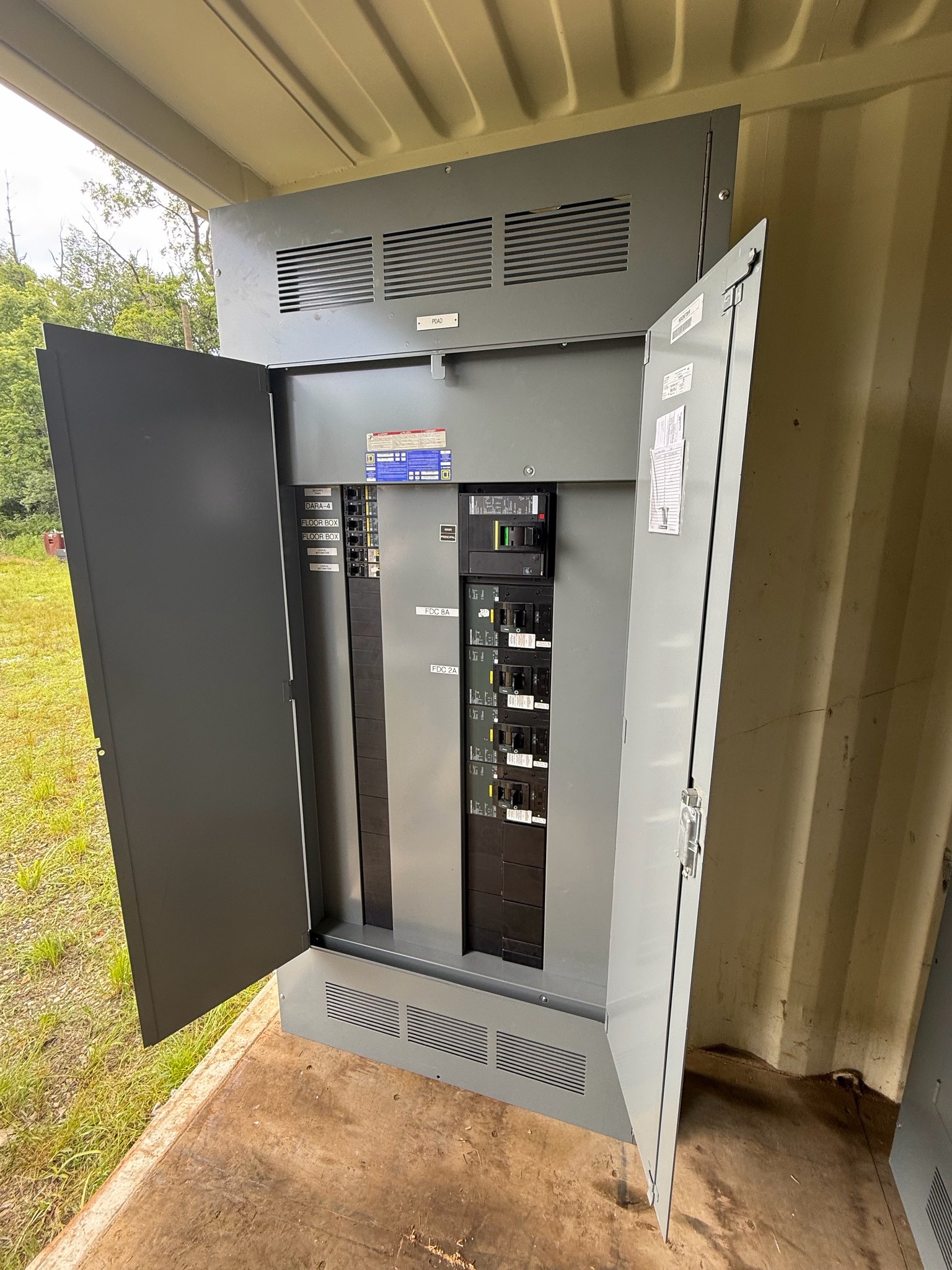
Record the voltage marking without treating it as a complete specification
Start with existing nameplate information, equipment schedules, drawings, or maintenance records. Preserve the wording and units as shown: a designation such as 277/480 volts, three-phase, describes a voltage configuration, not the board’s current-carrying rating. If documents use a different notation or appear inconsistent, share both versions and identify their source rather than choosing one as definitive.
A 277/480V designation commonly describes a three-phase system in which 480V is measured phase to phase and 277V phase to neutral. That interpretation is useful context, not proof of how a particular board is wired or configured. For example, an old schedule might say 480V while a label says 277/480V; report the discrepancy and let the records and equipment details be reviewed together.
Separate voltage from amperage in every description
Voltage and amperage answer different questions. Voltage identifies the electrical potential rating or system designation; amperage expresses current capacity, such as a switchboard bus rating or the rating of an individual main or feeder device. A board described as 277/480V does not thereby have a particular ampere rating. Find ampere figures in the relevant nameplate fields, breaker markings, or reliable equipment schedules, and keep each figure tied to its component.
When sending information, distinguish a board-level rating from device ratings. A hypothetical description might read: “277/480V, three-phase; main marked 1600A; feeder breakers appear to have separate ratings; neutral provision not confirmed.” That is more useful than calling the whole assembly “1600 volts” or assuming a breaker’s amperage is the bus rating. If a marking is hard to read, say so rather than estimating.
Describe the neutral provision and what the records establish
For a 277/480V description, whether a neutral is present matters because 277V phase-to-neutral service depends on a neutral connection, while 480V phase-to-phase service does not. Use drawings, schedules, or existing exterior labels to describe the documented arrangement: for instance, whether records identify a neutral bus or a four-wire configuration. Do not open a section or touch conductors to verify it; an uncertain detail should simply be labeled unconfirmed.
A neutral provision in the records should not be confused with proof that every feeder uses the neutral or that the present installation matches an old drawing. Note whether the information comes from a nameplate, one-line diagram, panel schedule, or another existing document. If a hypothetical schedule identifies a neutral bus but the board’s section labels are incomplete, share that limitation so the configuration can be evaluated without overstating certainty.
Map feeder arrangement, sections, and included components
A concise feeder inventory helps explain how a switchboard is organized. From existing schedules or safely accessible exterior labels, note the number of sections, the main arrangement, and feeder positions or identifiers where known. Record each feeder’s marked amperage separately from the board’s voltage designation. Mention whether visible equipment includes breakers, metering compartments, or other sections, but do not operate devices or remove covers to gather details.
Configuration affects what is being offered, so clarify whether the described assembly is one complete lineup or only selected sections, and identify any known gaps or components removed before decommissioning. A hypothetical lineup might have a main section and two feeder sections, while its paperwork lists several outgoing circuits. That description gives a reviewer a starting point; it does not substitute for inspection or confirm that all listed devices remain installed.
Prepare a review that fits the site and the sale
Gather ownership or authorized-sale information, available equipment records, approximate dimensions if already documented, and exterior photographs taken from a safe location. Include the site’s general access constraints, such as whether a loading area is indoors, whether crane or rigging coordination may be needed, and any known scheduling or site-control requirements. Do not approach energized apparatus or try to establish its condition by opening, testing, measuring, or operating it.
An Illinois buyer of used, surplus, and decommissioned electrical equipment reviews switchboards in all voltage classes, including equipment from shut-down power plants and decommissioned data centers. Share the details for review; an offer and proposed removal plan depend on the specific equipment and site. For an accepted purchase, payment is upfront, and the buyer covers freight and coordinates appropriate disconnects, crane, rigging, loading, and hauling with qualified professionals. You are not asked to test, dismantle, rig, or move the board.
Common questions
If the board is marked 277/480V, can I state its amperage from that label?
No. Voltage and amperage are separate ratings. Report the voltage wording as marked, then cite bus, main, and feeder amperage only from their own markings or reliable records. Flag anything unreadable or uncertain.
How should I report a neutral bus if I cannot safely verify it?
Use existing drawings, schedules, or exterior identification and name the source. If those records are incomplete or conflict, describe the neutral provision as unconfirmed; do not open an enclosure or touch equipment to check.
What happens to removal and payment if the switchboard is considered for purchase?
Details are reviewed before any specific offer. For an accepted purchase, payment is upfront, freight is covered, and the buyer coordinates removal logistics, including appropriate disconnects, rigging, loading, and hauling with qualified professionals.